In-house productSubscription delivery
Subscription deliveries that schedule, route and bill themselves
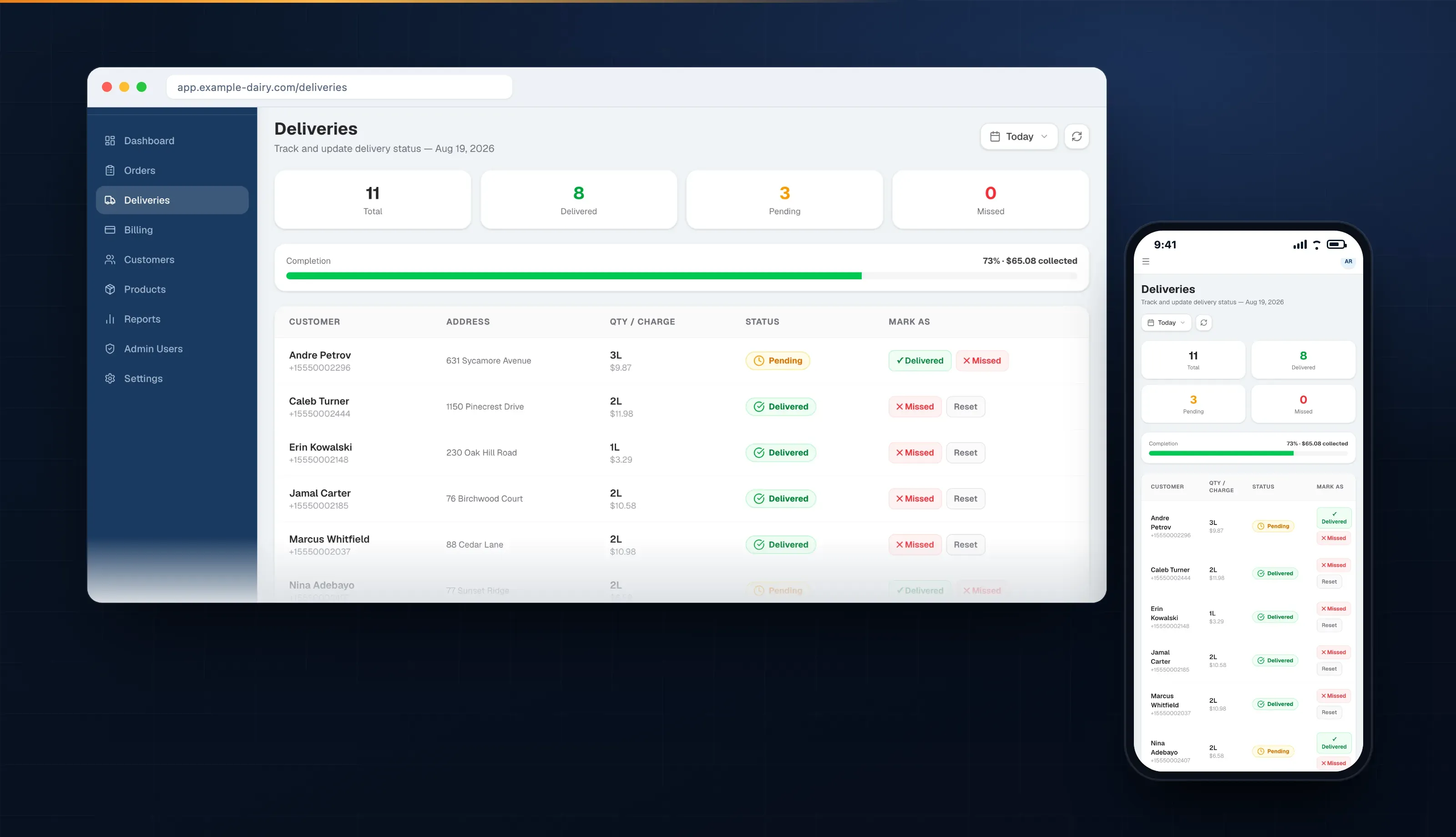
A recurring-delivery business where the operational load is not the deliveries themselves but the arithmetic around them — who gets what today, who paused, who owes, and what changes when one customer skips a week.
Who did this workBuilt and run in-house by our team. Shown here with demonstration data.
The result
2
portals — customer and operations — from one codebase
Technologies & disciplines
- Next.js
- React
- Express
- MySQL
- JWT authentication
- Scheduled jobs
The situation
Recurring delivery looks simple until you write down the rules. A customer takes two bottles daily, another takes three every other day, a third pauses for two weeks and expects the bill to reflect it. Someone has to decide, every morning, exactly what leaves the building and on which route — and then reconcile what actually got delivered against what gets charged. Done by hand, that job scales badly and gets more expensive precisely when the business is growing.
What we did
Modeled the subscription itself as the source of truth — quantity, frequency, and the specific weekdays it runs — so the daily delivery list is derived, never typed.
Generated each day's deliveries with a scheduled job that runs before the day starts, so the operations team opens the morning with the run already built.
Made the delivery record the billing record, so a missed drop reduces the bill without anyone remembering to adjust it.
Built the customer portal and the operations portal from one codebase, so a change to how a plan works cannot mean two different answers in two different places.
Kept every balance derived from movements rather than stored as a number, so a disputed bill can be walked back through the exact deliveries behind it.
The result
- Daily delivery runs generated automatically from active plans, with no manual list-building.
- Missed and completed deliveries feeding billing directly, so what is charged matches what was delivered.
- Customer and operations experiences shipped from a single codebase and a single set of rules.
What recurring revenue actually demands
Subscription businesses fail on arithmetic far more often than on demand. The hard part is that every exception — a pause, a skip, a changed quantity mid-month — has to flow through scheduling and billing without a human remembering to make it.
We build these systems so the exception is a first-class case rather than a manual correction, which is the difference between a product that scales and one that quietly needs another admin hire.
Keep reading
More work
~1.3×operational efficiency after launch
Sagawa Express. A national courier's pickup requests arrived by phone and were tracked in spreadsheets. Our team designed the online booking platform and driver application that replaced both.
48,000+parking lots managed on the platform
Tokup. A reservation product covering tens of thousands of parking lots nationwide, where the design problem was density — finding one usable space quickly, on a phone, in a hurry.
~1Mrequests per day handled by the Go services
Platform-as-a-service product, Dubai. Core backend, microservices, billing and the internal tooling that let an entire engineering team run the production stack locally — plus Go services elsewhere handling roughly one million requests a day.
5sales channels in one order queue
In-house product. A grocery business selling through five channels at once, where the real cost was not selling — it was the nightly reconciliation between a register, a spreadsheet, a phone and an online store that never quite agreed.
6service lines, each with its own page
A facility-management company. Its buyers are procurement teams comparing vendors on paper, so the site has to make the single-vendor argument itself — and then make the inquiry effortless.
3practices under one custom admin
An e-commerce agency. Three distinct practices and a service catalog too large for a static site, where the requirement was that the client could restructure their own offering without a developer.
Tell us what you are trying to build.
A 30-minute call with the people who would do the work — not a sales team. We will tell you honestly whether we are the right team for it.
- On the call
- Your goals, what exists today and the first steps. No account manager in between.
- Afterwards
- A written scope and a price within days — or a straight answer that we are not the right team.
- No obligation
- Nothing is committed until a scope is signed, and anything we send you is yours to keep.
We reply to every inquiry within one business day. Prefer email? info@sparqweb.com